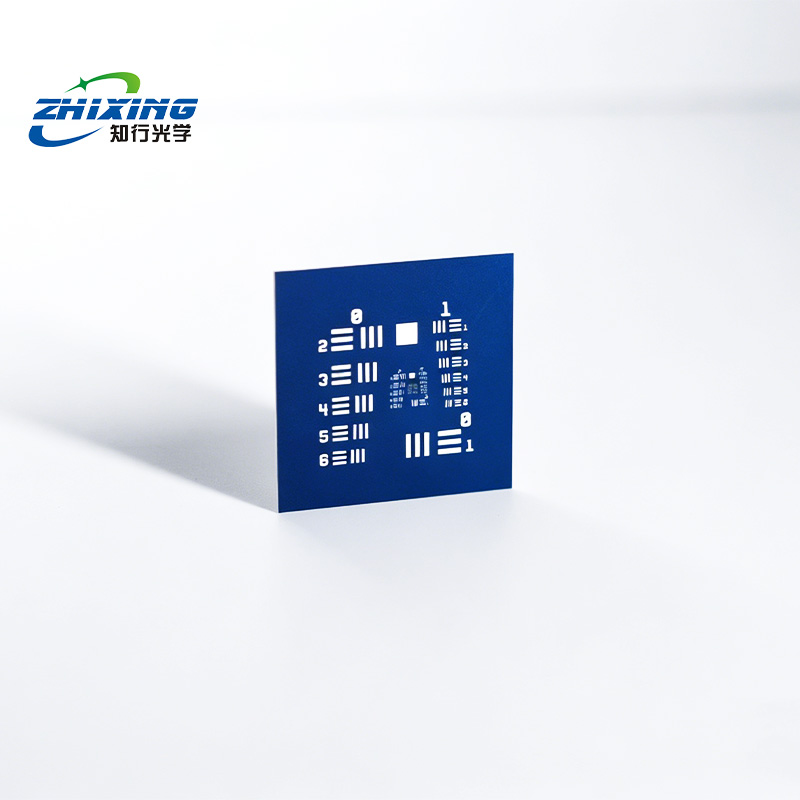
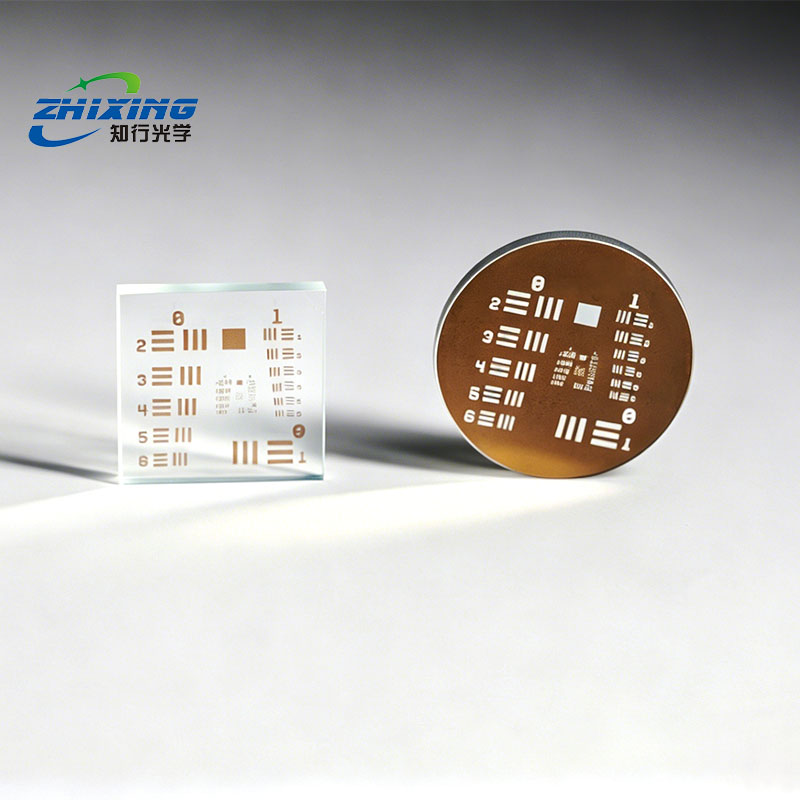
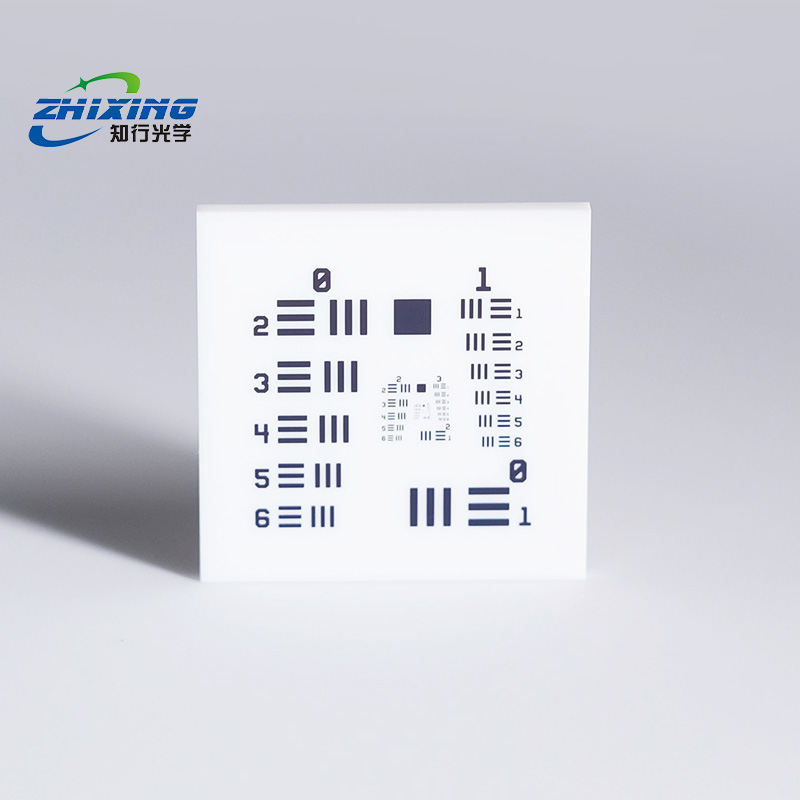
USAF 1951 Resolution Test Target
The USAF 1951 (MIL-STD-150A) is the most widely used resolution test target for optics, cameras, and microscopes. The core principle is to identify "the smallest three-bar group that can be clearly resolved."
I. Understanding the Target: Structure & Markings (Quick Identification)
1.Element
Each small block = 1 element, consisting of 3 horizontal bars + 3 vertical bars (bar width = bar spacing).
Resolved: All 3 bars are distinct, sharp, and not merged.
Unresolved: The 3 bars blur into a single mass and cannot be counted individually.
2.Group
From the outer edge toward the center of the target, bars become progressively finer and resolution increases.
Common groups: -2, -1, 0, 1, 2, 3 (higher numbers indicate finer patterns).
Each group contains 6 elements (1–6); Element 1 is the coarsest, and Element 6 is the finest.
3.Layout Quick Reference (Navigate Without Getting Lost)
Odd Groups (-1, 1, 3…): Start at the top-right corner; Elements 1→6 are arranged from top to bottom.
Even Groups (-2, 0, 2…): Start at the bottom-right corner; Element 1 is at the bottom-right, and Elements 2→6 extend to the left.
II. Pre-Test Preparation (Critical! Inaccurate Setup Invalidates Results)
Placement: Center the test target in the field of view and ensure the target surface is strictly perpendicular to the optical axis (tilting will cause measurement errors).
Illumination: Use uniform, glare-free lighting with high contrast (optical density difference ≥2.0). Avoid side lighting.
Focus: Achieve precise focus. Disable all in-camera/software sharpening, noise reduction, and distortion correction (these create "false sharpness").
Distance: Set the camera/lens-to-target distance ≈ focal length × 25 (e.g., ~1250 mm for a 50 mm lens).
Magnification Correction: If the system applies magnification or minification, final resolution = measured reading × magnification factor.
III. Visual Reading: 3 Simple Steps (Most Common Method)
Step 1: Find the Limit from Coarse to Fine
Start from the outermost (coarsest) group and examine each group and element sequentially:
If you can clearly count 3 horizontal + 3 vertical bars → record it.
Continue until you reach a group/element where the bars merge into an indistinguishable blur → the previous element is your resolution limit.
Step 2: Record "Group + Element"
Example: You can clearly resolve Group -1, Element 4, but finer elements blur → your limit is -1-4.
Step 3: Look Up Table / Calculate Resolution (2 Methods)
Alternatively, use the standard USAF 1951 lookup table to directly convert Group-Element to lp/mm or line width (µm).
Universal Formula:
Resolution (lp/mm)=2 Group+ (Element−1) /6
IV. Common Pitfalls (Avoid These Mistakes)
False Resolution: Bars appear as "spurious lines" or incorrect counts after merging → refocus or adjust the viewing angle.
Horizontal vs. Vertical Discrepancy: Record horizontal and vertical limits separately (lenses may exhibit directional differences in resolution).
No Post-Processing: Sharpening/noise reduction can make blurred bars appear "sharp," yielding falsely inflated results.
Forgetting Magnification Factor: Microscope or telephoto lens measurements must be multiplied by the magnification factor; otherwise, reported resolution will be erroneously low.